Welcome to Beyond the Pen, a captivating digital realm where words transcend their ink and take on a life of their own. Join us on an extraordinary journey as we explore the boundless landscapes of knowledge, creativity, and inspiration.
June 5th every year , the world unites to celebrate World Environment Day. This globally recognized event serves as a reminder of the importance of our environment and our collective responsibility to protect and preserve it. With environmental issues such as climate change, deforestation, and pollution becoming increasingly imparitive, this day provides platform to individuals, communities, and governments to come together and take concerte action towards a robust and sustainable future.
Imparitive of World Environment play's a crucial role in raising awareness about environmental challenges and the impact of human activities. It serves as a catalyst for change, encouraging individuals and organizations to evaluate their ecological footprint and take steps to minimize their negative impact on the environment.
The Significance of Taking Action:
Environmental Conservation: World Environment Day provides a platform for individuals and communities to come together and actively participate in conservation efforts. By planting trees, cleaning up natural spaces, and promoting biodiversity, we can protect and restore our ecosystems.
Sustainable Development: Addressing environmental issues is closely linked to sustainable development. By embracing eco-friendly practices, reducing waste, promoting renewable energy, and adopting sustainable agriculture, we can create a better future for generations to come.
Advocacy and Policy Changes: World Environment Day also empowers individuals to become environmental advocates and catalysts for policy change. By raising our voices, supporting environmental organizations, and engaging with policymakers, we can drive significant change at a local, national, and global level.
Education and Awareness: World Environment Day encourages educational institutions to incorporate environmental topics into their curricula, fostering a generation that is environmentally conscious and equipped with the knowledge and skills to tackle future challenges.
Action to be taken by us on World Environment Day
Individual Actions: Simple changes in our daily lives can make a significant difference. Reduce, reuse, and recycle; conserve energy and water; choose sustainable transportation options; support local and organic products; and educate others about the importance of environmental stewardship.
Community Involvement: Engage with local organizations, community groups, and environmental initiatives to organize tree-planting drives, clean-up campaigns, and awareness programs. Collaborating with like-minded individuals amplifies our impact and creates a sense of shared responsibility.
Corporate Responsibility: Businesses have a crucial role to play in sustainable development. Companies can adopt eco-friendly practices, minimize waste generation, invest in renewable energy, and promote sustainability throughout their supply chains. Encouraging employees to participate in World Environment Day activities further strengthens their commitment to environmental stewardship.
Policy Advocacy: Engage with local and national policymakers to advocate for environmental regulations and policies that promote sustainable practices. Support initiatives that protect natural resources, conserve biodiversity, and mitigate climate change.
At the end .
World Environment Day serves as a powerful reminder that we all share the responsibility to protect and preserve our planet. By recognizing the importance of nature, embracing sustainability, and taking action in our daily lives, we can create a positive and lasting impact. Let us use this annual celebration as a catalyst for change, inspiring ourselves and others to build a future where the environment thrives, and all living beings can flourish. Together, we can create a world that is environmentally sustainable and resilient for generations to come.
Why to save & invest money for future? Here are 10 simple reasons
POSTED BYJAGOINVESTORONJANUARY 8, 2021
Are you saving for the future? NO or YES?
If you are, then you must be wondering what a stupid question that is, because it’s so obvious that one needs to save money for the future. We all do it anyways!
You are WRONG!
Trust me, in last 10 yrs – we have dealt with so many investors who are not as prudent and forward-looking as you are. Many investors are hand to mouth when it comes to saving money. They are just postponing their savings in future and relying on luck or maybe they are not giving putting enough energy to save money.
So today, I thought of writing about 10 simple reasons why one should save and invest their money for the future. I want these 10 points to act as a reminder to you. Note, when I say “Save” in this article, it means “Save and invest”!
Let’s start
Reason #1 – It will help you in bad times
We all know that life is dynamic and bad things can happen. One may lose a job and become jobless some day. Or one may need lots of money to admit a loved one in the hospital. You never know what the future has in store!
If you have enough savings with you, you will be able to handle the situation in a much better way and won’t have to run around to others for money. There are always phases in life when things are going bad and if you don’t have savings, it can trouble you!. So savings help you in bad times!
Reason #2 – One day you will stop earning
At times, I am surprised to see many people forgetting this simple point, that one day they will stop earning.
That’s called “Retirement”
I see many people in their 30’s and 40’s behaving as if they will keep getting salary in their bank account all their life. They don’t take enough efforts to save money. They keep delaying their plans to invest and one day they realise that they are now in danger zone!
Dont forget that after you start your job, the expenses will never stop after that, but your earning will come only till you are 55-60 yrs!.
Reason #3 – To have peace of mind
One always feels a sense of security and peace of mind, when you have enough wealth to fall back on.I am talking about the day to day feeling you go through when there is bad news coming in.
Imagine situations like
Talks of layoffs in your company
Thoughts of getting someone hospitalized in the family.
News of your children school raising the fees .. AGAIN!!
All these small things in life will subconsciously haunt you and you will not have peace of mind because you know deep down you have no savings or less wealth. If something happens to your job, how will you manage things?
If you are working for many years, you will agree at there are some tough days, when you feel like just running away from everything and just chill out and enjoy life. You feel tired of corporate life and this rat race and all you wonder is – “If only I had enough wealth in my bank account”! ..
This also leads to a lot of stress and you may feel left-out compared to peers. Hence it’s very important to start saving for the future!
Reason #4 – To Get Financially Free
We all want to reach a stage in life when we dont have to depend fully on our salaries. We all want to create a level of wealth so that its enough to generate some income for us to handle our basic expenses at least. I am talking about financial independence.
When you start working, you have no wealth and you have to rely 100% on your salary. But over time, your wealth basket needs to go up in value so that if required – you can take out money if needed.
If someone needs Rs 40,000 a month for his expenses and he has 4.8 lacs savings – they know deep down that they at least have 1 yr worth of money with them.
With 48 lacs – they can last for 8-10 yrs (not considering inflation here)
This way, you reach a point in your life when your wealth itself is enough to create a stream of income which handles your basic expenses at least if not a lavish lifestyle.
Recently I tweeted – “Investing money is nothing but an act of gifting yourself more Retirement days”
If you have started your wealth creation journey on time – you are moving towards your financial independence slowly and maybe somewhere in your 40’s or 50’s (dont confuse this with your retirement) you will have some level of financial independence
Reason #5 – So that you don’t get into the debt trap
Remember that people who are into debt trap today started small. They got into a small debt first, and then they continued it, didn’t manage it well and now after many years, they find themselves into a deep debt trap. Think why they even started with the small debt like credit card debt or a small personal loan of 2 lacs?
Its because they didn’t have enough money saved!!. The root cause of the debt trap is because people do not save for the future, and then slowly have to rely on debt to fund their needs and desires.
Reason #6 – Feeling of Progress in life
Sense of “progress” is very important in your financial life. You may have ZERO bank balance at the start of a career. But if after working for 8-10 yrs, you have very less to show – then its crushes you from inside.
It’s like running for hours, only to realise that you have not moved much. If you do not save on time, then over a period you may feel like a failure because you dont see any progress in your wealth.
I also said in one of my tweets that “If your Net worth if not going up, you are probably a RICH SLAVE” and nothing more than that. Think about it!
And its not too tough to create wealth over time. A small sum of money can also turn out to be a big sum over a long period of time.
Check out how much wealth can you create just with the monthly SIP of Rs 10,000 in 30 yrs
Reason #7 – To handle major life events
A lot of major life events are going to come in your life.
Kids School fees (recurring)
Vacations (recurring)
Child Education Higher Education
Buying House
Upgrading of Car (recurring)
Home Renovation
Retirement
and lots and lots of small events which will demand money constantly!
What are you going to do – if you will not save enough for the future? Depend on Loans? Get into a Debt Trap?
Starting your wealth creation journey early in life increases the chances of you meeting these financial goals with less stress and on time without compromising on them!
Reason #8 – So that you can spend without guilt!
I have seen enough families who do not take enough vacations or spend properly on themselves enough. They keep cutting corners and often try to show that they are simple people and they dont believe in wasting money. But deep down the reasons is that they just don’t have wealth!
This means that on each occasion, they often feel guilty for spending money. They feel as if they are doing something wrong. They deprive themselves today so that they don’t have to deprive their future-self!
It doesn’t only impact them but their spouse, kids, parents and everyone around them at some level. A good financial life is not about just saving money, but spending money sensibly!
So start your saving today to that in future, when you have to spend money on things you love, you can do it with free mind without any guilt feeling!
Reason #9 – To explore an alternate career
A lot of people are not happy with their jobs. They feel stuck and they want to do something about it. But once you take a home loan and don’t possess any other skill, it becomes a permanent job for you.
You cant quit and explore other career choices because you have no backup plan. Forget switching career, ask yourself if you can even take a 2-3 yrs break from the job? Do you have enough wealth to support that?
If you save enough today, there will be a time when you will feel more comfortable to take that kind of tough decision. Having wealth on your side – gives you enough power to tell your boss that he sucks and that you are not coming from the next day!
You will be able to take calculated risks in life and try out many things .. so start saving now!
Reason #10 – Do that you can leave a legacy
I have many friends who have got enough legacy from their parents. Their money issues are partially solved. Imagine someone in a big city (Bangalore or Mumbai) whose parents are going to leave them a house or a big portfolio/business.
Only a person is burdened with a big EMI and no future inheritance can understand what I am speaking about.
One of my close friends has a Rs 10 crore net worth today (he is just 35 yrs age) all created by his grandfather. He has his own home, other properties and few income sources. Imagine how it would be for you if you were to acquire a lot of wealth from your ancestors!. What would be your mental state?
I am not saying that this itself will solve all your life issues, but you have one big less thing to worry about in life. You just build upon that!
You don’t get legacy because your parents messed up their retirement and didn’t do enough wealth creation. You can choose to not do that your next generation. I know that its a subjective thing and not everyone is excited or agree with the idea of leaving an inheritance.
Why we don’t save enough money when it’s so obvious?
Below is an excellent video from Shlomo Benartzi on why we don’t save enough and a framework to solve that issue. Listen to it!
A simple financial plan for you to invest your money
So here is a very generic roadmap on what you can do to invest your money
First, take enough term plan and health insurance early in life
Make sure you have 12 months’ worth of expenses invested in an ultra-short-term bond fund. This will give you good liquidity and decent returns at the same time!
Invest 20% – 40% of your take-home income into equities (as you already have debt portion covered by EPF). The options can be a mutual fund, Index funds, direct stocks if you understand it
Over time, as you grow older you may also have investments into debt mutual funds to lower the volatility of your portfolio
If you wish to, you can also have some fixed deposits – but preferably very less of it
If you are investing in NPS already, you have some equity exposure!
You can open a PPF account, but don’t over-invest in it at a young age!
The above suggestions are all generic in nature. If you are interested in wealth creation in a more focused and structured manner, you may want to look at our investments services brochure
The year 2020 was famous for multiple reasons. however, the most alarming ones include firstly due to covid 19 pandemic and secondly due to the flood of IPO which hit the secondary market.
Fig 1. IPO
In this digital age, there are several companies led by first-generation entrepreneurs who are doing extremely well within the country and globally, after establishing themselves in the primary market, they are eying to expand the product line further and establish a footprint worldwide. To do so huge capital is required and for that public participation becomes mandatory. That's why these companies are jumping into the sea of the stock market with the intention of making a big name. There was a time in the 1990s when investors /Participants used to experience huge first-day listing gains, and huge long-term gains also. But nowadays all companies hitting the market with IPO are getting listed at premium valuation with very little scope of future gains. Most of the IPO subscribers nowadays also get disheartened with their IPO prices going to red the very first day or when it takes a downhill path in the long term. one can easily make out from these situations that there is no sure-shot way of making money from the subscription of every IPO. Hence, finding a good IPO that is getting listed at the correct valuation is a paramount important factor for generating money from initial public offerings. It is difficult to shift through the riffraff and find the IPOs with the most potential, but certainly not impossible. A good IPO investment has certain traits. If you can get most of it right in the IPO you are planning to invest, then your chance of getting lucky is more. So, here are some IPO tips one must follow before subscribing to it.
Objective Research
If you are thinking of doing objective research by yourself, mind you it is not an easy task to discern the correct and accurate information about the company likely to go public. Unlike listed companies which are extensively covered by various analysts, very little information generally remains available in the public domain for the unlisted companies hence it is a herculean task to obtain the correct financial health of the company. Though companies are supposed to disclose the information in the Red Herring Prospectus, we have to understand that it is prepared by the company itself and they always try to shield the grey areas. The 3rd party websites may have been compromised to give biased views and the investment banks and brokers will have their own vested interests to portray the company they support in a good light. So what IPO subscribers should do..?
So, the rule is, look for the inclination of anchor investors before it opens for a subscription. Do not hurry to subscribe to the IPO on the very first day. Wait till the last day and look for the subscription of IPO in (QIB) Qualified Institutional Buyers category, If it is oversubscribed, then you can trust that IPO because the Institutions have better penetration into the Company's internal data than the retail individual investor. And you can be sure that the institutions will not put in their money where it won’t grow.
2. Leafing through the Prospectus.
As discussed above the companies try to conceal the unfavorable information from coming to the public domain while filing for IPO. However, the information divulged in the prospectus is generally correct. So it is always advisable to pursue the prospectus as it provides glimpses of possible risks and opportunities associated with the company.
fig 2. RHP
Also, companies disclose the action plan in terms of possible utilization of the capital which they are planning to generate from the listing on the stock exchange. Utilization of generated capital becomes another key factor that helps to decide should you subscribe for an IPO or give it a miss. Suppose they plan to utilize the generated capital for organic/inorganic growth, or enhancing the product line and expansion, which makes the optimistic future outlook of the company then you must think to subscribe to such IPO. Contrary to that if a company is planning to clear the debt out of the generated corpus then it may be worth giving IPO a miss.
3. Credibility of the Broker/Underwriter
Companies always choose underwriters very carefully based on certain criteria. However, If the underwriter is a big investment bank like Goldman Sachs or Morgan Stanley or any big investment bank then generally they would not like to associate their name with the company which has undisclosed issues. so if the investment bank which is helping the company in bringing the IPO into the market is strong and has a proven track record. Then chances are bright the IPO will be worth buying.
4. Invest at cut-off price
As you know the IPO always comes with a price band the lower price is called the floor price and the upper price is called the Cut- off price. If you are a retail individual investor and you are keen on increasing the chance of getting shares allotted then bid at the cut-off price. It will increase the chances for your application to be considered, whatever may be the final allotment price.
5. Look at the valuation
Valuation is the toughest parameter to conclude for retail investors. This process is extremely technical. Investment bankers and underwriters judge the quality of management and returns before arriving at the final offer price. Compare the valuation of the IPO in India in the secondary market with a listed peer based on sector and the ratios then it will help you to decide should you subscribe to the IPO or give it a miss.
fig 3 .Valuation
6. Select a good broker
Opening a Demat account with a good and famous brokering house sometimes assists you to get the allotment in the most-sought after IPOs which are quite hard to get. There are brokers or IPO portals that can open the door to new and interesting IPO stocks. They may have enough connections to ensure decent allocation for you.
7. The Bottom Line
Successful companies regularly go public but finding the apt opportunity and valuation is a tedious task. But it is wrong to say that all IPOs should be avoided, though. Some investors who bought the stock at the IPO price have been rewarded handsomely by the companies in question.
Just keep in mind that when it comes to dealing with the IPO market, skeptical investors with their fingers on the pulse are likely to see their holdings perform much better than those who are trusting and ill-informed. So be informed and take the right decision based on all the above-mentioned parameters. Finally, I will conclude by sayings
If we assess the personal financial profile of defense personnel there would be a very small number who actually manage their finances well and are able to generate adequate corpus to meet the personal financial goals comfortably by beating the inflation in the short span of service. The problems such as Paucity of time, separation from family, remote locations, and instability due to regular transfers and shifting are a few of the prominent difficulties which adversely affect financial planning. Lack of knowledge about the deeply rooted financial world due to being away from the mainstream, and absence of credible financial advisors are few other important factors that further aggravate personal financial management.
Two important scenarios and their effects
The factors which we have discussed above lead to non permanency and put the financial planning on the backburner. Whether, staying with family or staying separated from family are the two prominent scenarios. Both of these have their own challenges and requirements for money management. While most of the time defense personnel stay separated from the family mostly due to service requirements such as being posted to non-family stations and in far-flung areas and sometimes due to personal problems such as nonavailability of good schooling or some other family conditions. In such conditions, the expenditure would be double first being the personal expenses and second finances which would be required for maintenance of family at other location. Contrary if staying together poses a different set of problems shifting of luggage damages settling down at new location school admission etc leads to heavy outflow of money. In both scenarios, adequate liquidity is the most important factor. The requirement of liquidity can be fulfilled by the regular remuneration however it is important to keep at least 5 months salary in a fixed deposit which can be made available as and when the requirement arises.
Popular investment instruments of armed forces personnel.
One of the traditional and most popular methods of saving for decades is by putting the money into DSOP (Defence services officers provident fund ) /AFPP (Armed forces personnel provident fund ) depending upon the rank structure, which gives a compounded return and helps to generate the larger corpus in the long run. Serving defense personnel save a percentage of their basic salary in the DSOP fund. These funds are one of the best ways of creating a sizable corpus for goals, such as buying a house and have the requisite liquidity during retirement years. As a newly recruited in the armed forces, this should be one’s starting point. Get a decent sum deducted each month and increase the subscription during a field tenure or posting to a CI Ops, since additional allowance is given while expenses are lower. Avoid withdrawing from it since that destroys compounding. Finally, since DSOP subscription takes care of deduction u/s 80C, there is no need to invest in any instrument for tax-saving purposes. However, The recently presented Budget has made interest in PF contributions beyond Rs 2.5 lakh taxable. This leads to revisiting financial planning again. Other than DSOP/AFPP there are many other instruments available in the market which are comparatively less risky and generate good corpus in the long run.
Systematic investment plan in Index mutual funds
A mutual fund is a big market and nothing is free here. We often hear people saying “mutual fund Sahi hai”. It is true but we need to consider many factors before selecting the correct mutual fund which suits one's goal and does not require consistent monitoring. The few most important factors to be considered are the expense ratio and the size of the AUM (Asset under management) and the past performance of the fund manager managing your fund. However, If we believe in the growth story of our country which is the fastest emerging economy and as per BBC news India By 2050, is projected to be the world’s second-largest economy (overtaking the United States) and will account for 15% of the world’s total GDP. By analyzing the past figures, it will be understood that investing in the index mutual fund turns up to be a good decision in the long run. The BSE(Bombay stock exchange ) popularly know as Sensex started with 100 points at the time of its inception in the year 1979 and in fy 2021 it has touched 50000 points thus if we consider CAGR (Compounded annual growth rate ) It will be 15.96% over 42 years which no other asset class has given and since the economy is growing the Sensex will also grow in future and it does not require constant attention. It is suggested to avoid thematic mutual funds until one has sound knowledge of market movement and tracking the market regularly.
Equity Allocation
Create a portfolio of equity to beat the high inflation in the long run, with long-term goals, such as retirement plan, child’s education, child marriage, etc. While DSOP gives the predictable compounding effect, equities give the magical flavor in the portfolio if selected properly for value investing. If we take an example, the cost of education in India is skyrocketing. In 2007, the cost of a Medical Degree was 15.50 lakhs. In 2017, the cost of a Medical Degree rose to `41.43 lakhs. In 2027, the cost of a Medical Degree, assuming a 10% rate of inflation, will be appx. 173 lakhs. Thus, it is crucial to invest a part of the savings in an asset class that can beat inflation and ensures that money will grow to match future money needs.
Some DOs
1.Due to the paucity of time it is always advisable to have a compact and clean portfolio that does not require consistent monitoring.
2. Spend Less Than You Earn, it is a very good practice for wealth creation if you spend less you save more, and with the saved amount you will be able to create a big corpus.
3. Live a debt-free life. Avoid unnecessary loans and multiple credit cards. While a home loan is fine. Don't fall prey to credit card companies.
4. Keeping heavy money in fixed deposits should be avoided because interest earned is taxable and keeping inflation into account it will generate a negative return.
5. Don’t buy property merely for tax saving or just for rental income. Rental income is taxable. Invest in the house which you are planning to live in after retirement.
6. Moneywise be wise do not invest without thorough investigation and do not take decisions in haste.
7. Invest in Sovereign Gold Bonds which are issued by RBI in six tranches every year and earn interest of 2.5 % every year. With the mismatch in demand and supply, the is likely to soar further and will hit 1.5 lakhs per gram by 2030.
8. Keep your spouse involved in money matters.
9. For investing directly in equity always remember to buy right and sit tight
10. Buy a medical insurance plan by keeping the pandemic such as covid -19 in mind.
Some Don'ts
Don't buy insurance-plus-investment products. Understand both are totally different from each other. While AGIF (Army Group Insurance Fund) subscription contributes towards insurance. Depending upon the rank, insurance covers are for around ₹50–75 lakhs. Since there is a provision of family pension, the need for insurance cover is comparatively limited.



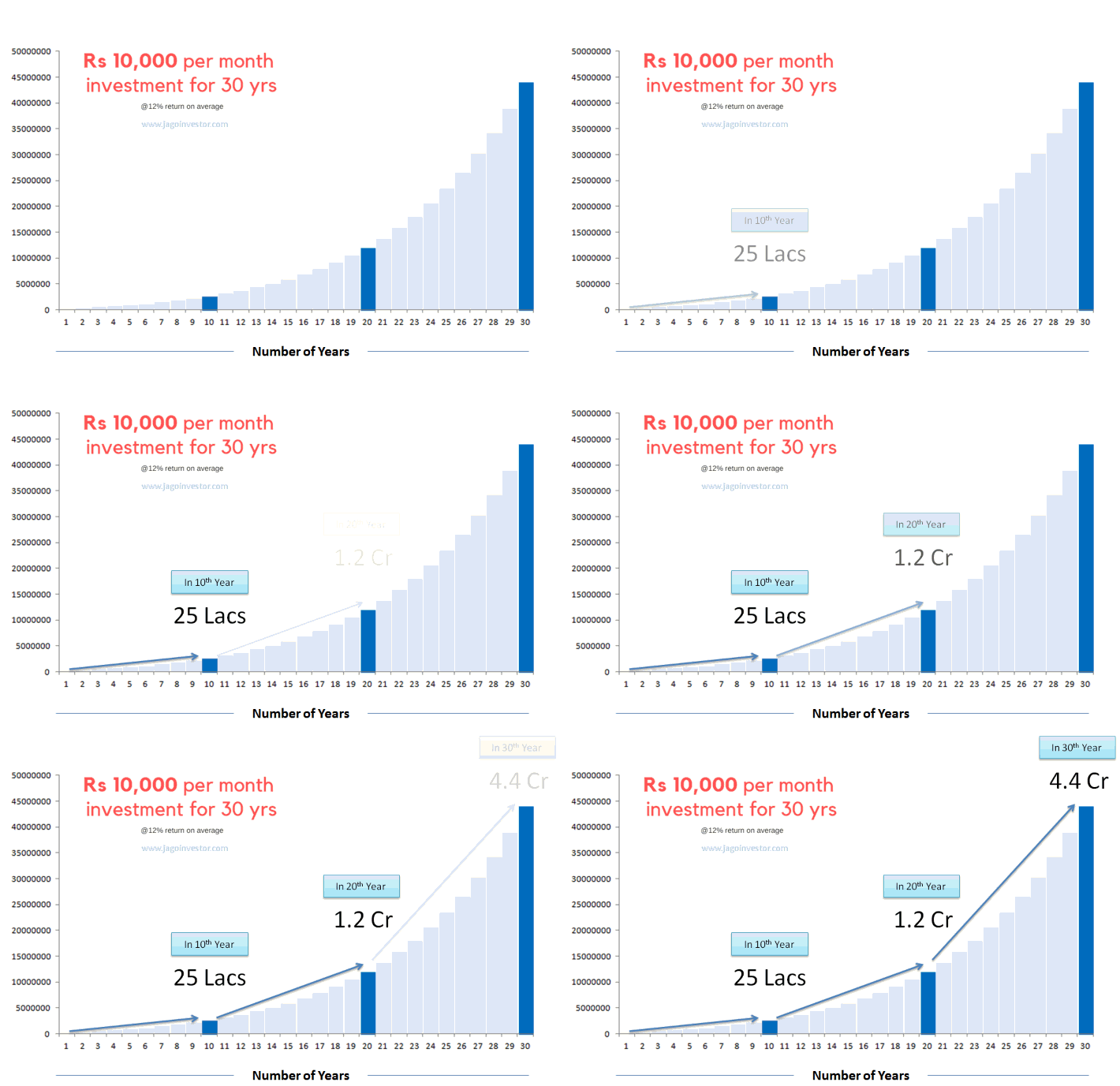


 fig 3 .Valuation